
Apache 2.0, weights free, and at 30.7 million parameters this is the lightest detector in the catalog. Self-hosting needs PyTorch and the Hugging Face transformers library, and a GPU helps but is not required. In your browser it runs on CNAPS Studio, included in the basic plan.
The name is an acronym worth unpacking, because it explains the design: You Only Look at One Sequence. Every other detector here starts by running a convolutional network over the image to extract features. This one skips that entirely, cutting the picture into 16 by 16 pixel patches and feeding them to a transformer as a plain sequence, the same way a language model reads words.
The cost of that purity is accuracy. It scores 36.1 on the standard detection benchmark where DETR, which is only a third larger, scores 42.0. Three general detectors sit in the CNAPS Studio catalog, and this is the one you pick when size and simplicity matter more than the last six points.
What it actually is
A small vision transformer with a detection head bolted on. Twelve layers, twelve attention heads, 384 hidden dimensions, and 100 object queries that each go looking for one object. The queries and the training method come straight from DETR; what is different is that nothing convolutional happens first.
Training ran in two stages. Pre-training on ImageNet-1k for 200 epochs taught it to see, then fine-tuning on COCO 2017 for 150 epochs taught it to detect the 80 everyday categories in that dataset. The 100-query ceiling carries over from the DETR design, so no image returns more than 100 objects.
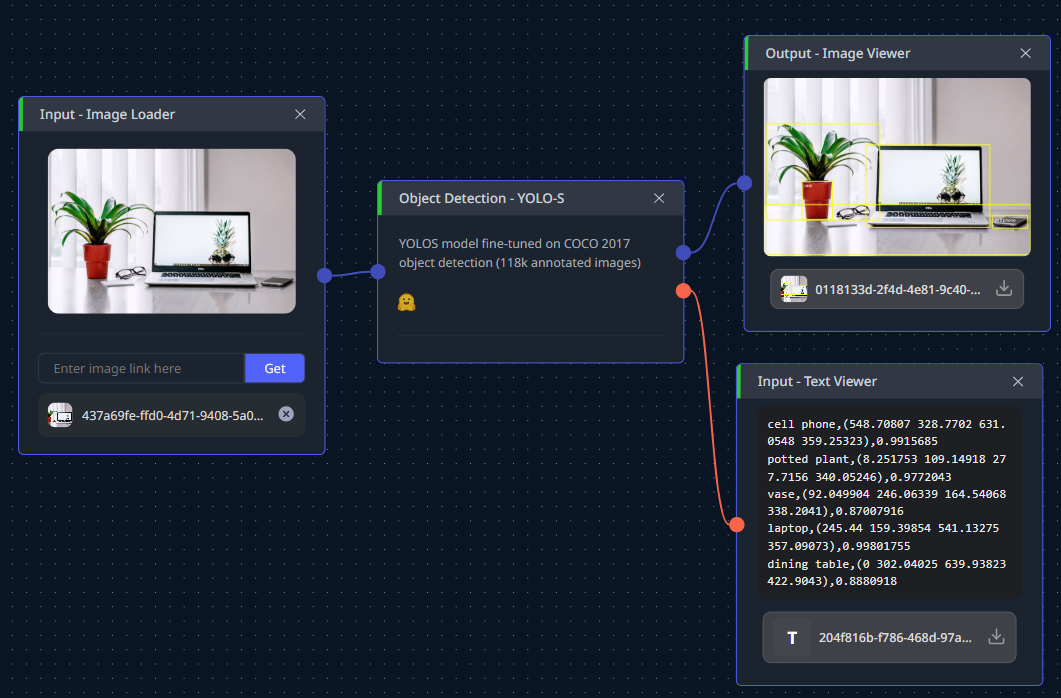
Output is the standard detector list: a class label, a box given as left, top, right and bottom coordinates, and a confidence score from 0 to 1 for every object found.
Parameters30.7 millionArchitectureSmall vision transformer, no convolutional backboneEncoder12 layers, 12 attention heads, 384 hidden dimensionsPatch size16 by 16 pixelsObject queries100, which is also the maximum objects per imageClasses80 everyday COCO categoriesPre-trainingImageNet-1k, 200 epochsFine-tuningCOCO 2017, 150 epochsLicenseApache 2.0Downloads last month737,780
The published numbers
The model card reports 36.1 average precision on the COCO 2017 validation set. That measure is scored out of 100 and rewards both finding the right objects and boxing them tightly, averaged across how strictly the box has to match.
That is the only accuracy figure published, and it is the author's own. As with DETR, the mitigating factor is that COCO average precision is the single most reproduced number in computer vision, and this model has been downloaded 737,780 times in the last month, so a wrong figure would not survive long.
One claim in our own documentation does not hold up. Our page says this model achieves accuracy similar to DETR. The published figures are 36.1 against 42.0, which is a gap of almost six points on a hundred-point scale, and that is not similar. Our page also quotes inference times for both models that appear in neither model card. The figure above is the one with a source.
How it compares to the other detectors here
YOLO-SDETRRF-DETR MediumBackbonePure transformer, no convolutionsConvolutional, then transformerVision transformer, then deformable decoderSize30.7M, the lightest here41.6M33.7MClasses80 everyday COCO categories91 everyday COCO categories80 everyday COCO categoriesCOCO average precision36.1, author-reported42.0, author-reported54.7, measured in-house by RoboflowOutputLabelled boxes with confidence scoresLabelled boxes with confidence scoresLabelled boxes with confidence scoresLicenseApache 2.0Apache 2.0Apache 2.0Downloads last month737,780613,233See its own post
All three scores are COCO average precision on the same validation split, which makes this a genuinely fair comparison by the standards of this series. The one caveat is that the RF-DETR figure was measured by Roboflow in-house rather than taken from its own paper, so treat that gap as approximate while the YOLO-S and DETR pair are directly comparable.
The practical read is blunt. RF-DETR Medium beats both older models on accuracy and speed, so it is the sensible default. Reach for YOLO-S when the deployment target is small, when you want the simplest possible architecture to reason about or fine-tune, or when you are studying how far a transformer gets with no convolutional help. Reach for DETR when you need the wider 91-category list. And when the target is not on any category list, SAM 3.1 (Scene) finds it from a text phrase instead.
What to chain it with
One image in, a list of labelled boxes with confidence scores out. That is the same shape every detector here produces, so it slots into the same chains without any adaptation.
Three are worth naming. Image Crop by Class cuts out every object carrying one label, turning a shelf photo into one image per product, which then goes to Object Classification for a closer look. Image Masker by Class converts the boxes into a mask that Selective Blur can obscure or PowerPaint can erase. And Image Gate by Text passes an image onward only when a chosen label appears, which turns the detector into a filter for a large batch rather than an annotator for one picture.
Open YOLO-S in CNAPS Studio, run the same twenty images through it and through RF-DETR Medium, and count the objects each one missed before you decide the smaller model is enough.
Sources
- huggingface.co/hustvl/yolos-small for the Apache 2.0 license, the 30.7 million parameter count, the 36.1 average precision on COCO 2017 validation, the two-stage training schedule, and the monthly download count.
- huggingface.co/facebook/detr-resnet-50 for DETR's 42.0 average precision, its parameter count and its download count.
- github.com/roboflow/rf-detr for RF-DETR Medium's 54.7 average precision and the note that Roboflow measured it in-house.
- docs.cnaps.ai/ai-model-hub for the CNAPS Studio input and output and the other detectors in the catalog.