LTX-2.5: 1080p video with its own soundtrack from one prompt, and where to run it
Community license, weights free to download, commercial use free for companies under USD 10 million in yearly revenue. Self-hosting means about 71GB of weights read for every clip, 81GB with the prompt enhancer, plus Python 3.12 and CUDA 12.7 or newer; Lightricks offers 8-bit weights and CPU offload for smaller cards but publishes no memory figure. In your browser it runs on cnaps studio, included in the basic plan.
It writes the picture and the sound together. From a text prompt, or a prompt and a first frame, it returns a 1080p clip with a matching 48 kHz stereo soundtrack: dialogue, footsteps, room tone, whatever the prompt describes. In the example below, one prompt described both the line she speaks and the kettle behind her.
The cost is control. Every clip is 121 frames, about five seconds at 24 fps, and the distilled recipe has no steps, guidance or negative prompt to tune. Eight video generation models sit in the cnaps studio catalog, and this is the one for full-resolution clips with sound from text.
What it actually is
A 22-billion-parameter audio and video diffusion transformer from Lightricks, run as its distilled checkpoint with a custom 12-billion-parameter text encoder. Version 2.5 adds a new diffusion decoder in place of the usual reconstruction stage, compute that scales with scene complexity, and native multi-shot generation.
The studio runs the official two-stage recipe: 8 steps at half resolution, a 2x latent upscale, then 3 steps at full size. An optional prompt enhancer, Gemma 4 E2B, rewrites short prompts and also sees the image.
In cnaps studio you give it text and, optionally, an image that becomes the first frame. Four canvases are offered, default 1920 by 1088, with 1088 by 1920, 1536 by 1024 and 1024 by 1536. Longer, more specific prompts that name subject, action, camera and sound give steadier results than short ones.

1. Text to video
Prompt only, no image. Picture and sound come out of the same run. Turn the sound on to hear it.
"A golden retriever puppy runs through a sunlit meadow of wildflowers toward the camera, ears flapping, tongue out, happy. Warm golden hour light, shallow depth of field, low camera angle, smooth tracking shot, cinematic and photorealistic. Sound: birds chirping, soft wind, light footsteps on grass, no music, no speech."
1920×1088 (16:9) · 121 frames (~5 s) · prompt enhancer off
2. Image to video (first frame)
The still below was made with Z-Image-Turbo in the same flow and connected to LTX-2.5 as the first frame. The video starts from that exact picture and adds the motion and the rain sound.
First frame
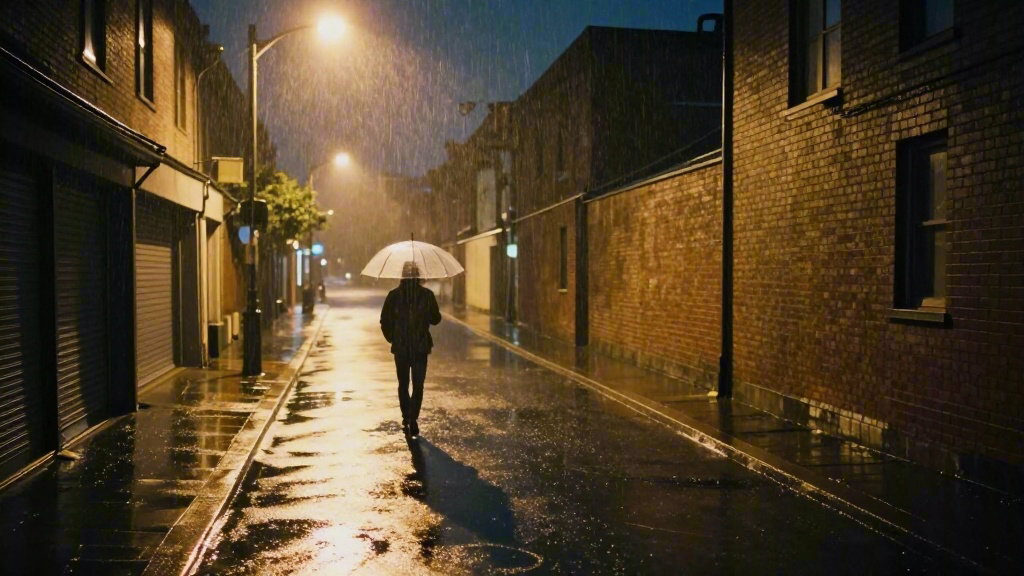
"A quiet city street at night in steady rain. The camera stays still at street level. A lone person holding a clear transparent umbrella walks slowly away from the camera down the middle of the wet road. Raindrops bounce off the umbrella; small ripples spread across the puddles. The wet asphalt reflects the warm glow of the streetlights. Audio: the steady patter of rain on the street and on the umbrella, light splashing footsteps on wet pavement. No music, no speech."
Flow: Text Input → Z-Image-Turbo → LTX-2.5 (image port) + Text Input (prompt port) → Video Viewer · 1920×1088 · prompt enhancer off
Want to try it with a ready-made example? Follow our step-by-step guide to creating an AI video with sound. It walks through the blacksmith sample, writing a prompt for both picture and sound, and running the Home card.
The published numbers
Lightricks has published no scores for 2.5. The paper describes its predecessor, LTX-2, a 19B model with separate 14B video and 5B audio streams, and its speed test uses 121 frames at 720p on one data-centre GPU.
The speed gap, about 18 times per step, comes from the authors' own test. The rankings come from an independent arena that pits public models against each other, measured in November 2025.
Treat all of it as a floor for 2.5. The newer version changes the decoder, the text encoder and the distilled model, and no one has scored those changes yet.
How it compares to the other video generators here
These four share no published test, so the table maps resolution, length and sound. The deciding questions are how large the frame must be and whether the clip needs its own audio.
Reach for LTX-2.5 when the shot must be 1080p and come with sound. Reach for MiniMax H3 for longer clips that follow a reference, Wan2.2 TI2V 5B for quick silent drafts, and Cosmos3 Nano to extend footage you already have.
What to chain it with
Text and an optional first frame in, a finished clip with sound out, so it often stands alone or opens a chain.
Two chains suit it. Before it, Z-Image-Turbo or FLUX.2 Klein 4B can design the first frame, since only the opening image can be fixed. After it, LatentSync 1.6 can put a recorded voice on the speaker, or reach for LTX-2.5 Audio-to-Video when you already have the voice.
Open LTX-2.5 in cnaps studio, write one prompt that names the sound as well as the picture, and compare it with the same prompt and the enhancer switched on.
FAQ
What does LTX-2.5 need to run locally?
A large GPU and plenty of disk. The weights come to about 71GB, or 81GB with the prompt enhancer, and are read for every clip. Lightricks lists Python 3.12, CUDA 12.7 and 8-bit or offload options for smaller cards, without a memory figure. In cnaps studio it runs in the browser, included in the basic plan.
Can I set the steps or guidance?
No. The studio runs the distilled two-stage recipe, which fixes the steps and runs without guidance or a negative prompt. To steer the result, write a longer prompt that names subject, action, camera and sound, or switch on the prompt enhancer, which rewrites short prompts and also looks at your image.
Can I use LTX-2.5 output commercially?
Yes, for most teams. The LTX-2.x Community License allows commercial use for companies under USD 10 million in yearly revenue, while larger companies need a paid license from Lightricks. Lightricks claims no rights in the output, and the license asks you to disclose machine-generated content.
