Apache 2.0, weights free, commercial use allowed. Self-hosting is light by audio-model standards: about 1.3 billion parameters, with code in the OpenMOSS repository; no memory figure is published, and the first call can take minutes while the code compiles. In your browser it runs on cnaps studio, included in the basic plan.
It does one job: one English sentence in, one sound effect out. A creaking door, rain on a tin roof, a crowd in a stadium, an engine starting in the cold, a phone buzzing on a wooden table. The result is a 48 kHz mono WAV from half a second to thirty seconds, peak-normalized so it drops straight into an edit.
The cost is scope. In the studio prompts are English only, output is mono, and the model is meant for effects and ambience, so speech and music belong to other models. Four audio models sit in the cnaps studio catalog, and this is the one for sound effects.
What it actually is
MOSS-SoundEffect v2.0 from the OpenMOSS team, released in May 2026. It is a diffusion transformer trained with flow matching, with a small language model as its text encoder and a neural audio codec turning the result into a waveform. The first version was an 8B model; version 2 shrank the backbone to 1.3B.
The studio always renders a 30-second window and trims it to the length you ask for, which is why a two-second click and a twenty-second storm take about the same time, roughly seven seconds per clip.
In cnaps studio you type a description. Duration runs from 0.5 to 30 seconds, default 3. Advanced settings cover steps from 20 to 200, default 100, guidance from 1 to 10, default 4, and a seed, where -1 picks a new one. Those defaults match the settings the model card recommends.
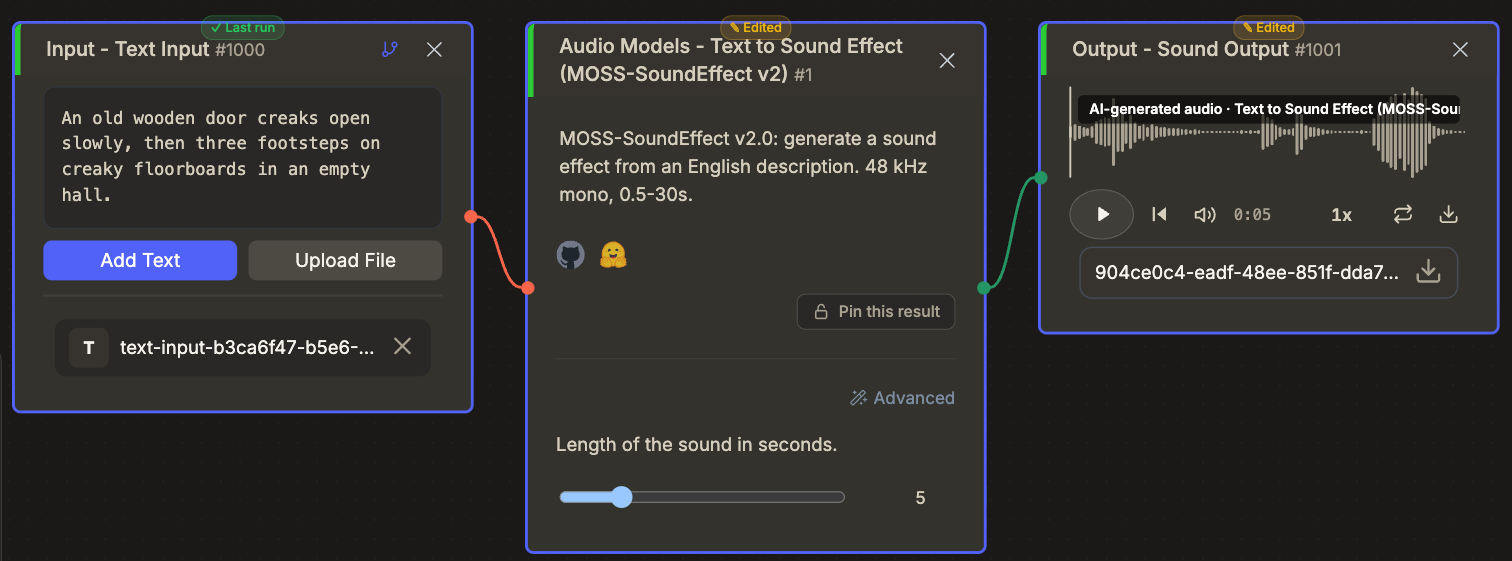
Photo to a living scene with sound
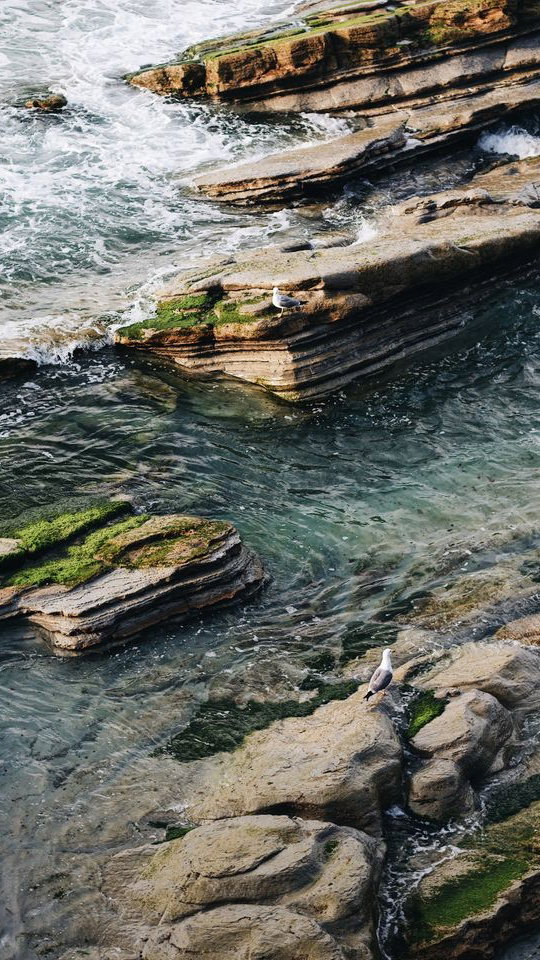
One photo goes in. Gemma 4 looks at it and writes two sound descriptions, MOSS makes both sounds, and they are mixed onto a short video animated from the same photo.
Input photo
The two MOSS prompts (written by Gemma 4 from the photo)
Ambience, 6 s: "The rhythmic crashing of ocean waves against jagged coastal rocks creates a powerful, echoing roar that fills the open seaside air."
Accent, 2.5 s: "A sharp, piercing seagull cry echoing over the crashing waves of a rocky coastline."
Mixed onto the video — waves from 0 s, gull cry at 1.2 s
Flow: Image → Gemma 4 (prompts) → Cosmos3 Nano (video: only the water moves, the birds stay still) + MOSS ×2 (sounds) → Sound Collect → Audio Mix → Audio Replace
The published numbers
OpenMOSS has published no benchmark scores for the sound effect model, and its technical report covers the team's speech models only. What is on record are the model card's recommended settings and the studio's own measurements.
The fixed window has a practical upside: there is no reason to generate short and stretch later. Ask for the exact length the edit needs, and make a few takes with different seeds instead.
Without published scores, judge it by ear on your own prompts, and keep the seed of any take you want to match later.
How it compares to the other audio models here
These four do different jobs and share no test, so the table maps outputs. The question is simply whether you need an effect, music or a voice.
Reach for MOSS for footsteps, weather, machines and room tone. Reach for Text to Music (ACE-Step 1.5) for a score, Qwen3-TTS for narration in a preset voice, and Qwen3 Voice Design when the voice has to be invented.
What to chain it with
A sentence in, an effect out, so it usually sits beside a video model rather than after another audio model.
Two chains suit it. Silent clips from Wan2.2 TI2V 5B, or from Cosmos3 Nano with its own sound switched off, get their effects here. And when you are not sure how to describe a shot, Gemma 4 31B can look at a frame and write the sound description for you.
Open MOSS in cnaps studio, describe one sound with its material and setting, and run three seeds to hear how much takes vary, then keep the one that fits the cut.
FAQ
What does MOSS need to run locally?
The OpenMOSS repository, a GPU and the 1.3B checkpoint. No memory figure is published, and the first call can take several minutes while the code compiles. The model card's recommended settings are 100 steps and guidance 4. In cnaps studio it runs in the browser, included in the basic plan.
Why does every clip take about the same time?
The studio always renders a full 30-second window and then trims it to the duration you set, so a short effect costs as much as a long one, about seven seconds. Set the exact length the edit needs from the start, and spend the time on extra takes with different seeds.
Can MOSS make speech or music?
It is built for effects and ambience, and in the studio it takes English prompts and returns mono audio. For speech, use Qwen3-TTS or Qwen3 Voice Design, and for music, Text to Music (ACE-Step 1.5). Mixing the three gives a complete soundtrack for a silent clip, with each layer adjusted separately.
