
RF-DETR Medium: fast, accurate boxes over 80 everyday categories, and where to run it
Roboflow released the RF-DETR family under Apache 2.0, so the weights are free and the terms are the permissive standard ones. At 33.7 million parameters self-hosting is undemanding: the Hugging Face transformers library, PyTorch, and a GPU if you want the real-time speeds it was built for. In your browser it runs on CNAPS Studio, included in the basic plan.
What sets it apart is that it was not designed by hand. Roboflow ran an automatic search over architecture choices, measuring accuracy and latency for each candidate, and kept the ones that sat on the best trade-off curve. Medium is one point on that curve, and the result is a detector that is both more accurate and faster than the older transformer detectors it descends from.
The cost is a fixed vocabulary. It knows 80 everyday categories and nothing else, so anything outside that list is invisible to it no matter how obvious it looks to you. Three general detectors sit in the CNAPS Studio catalog and this is the balanced default: more accurate than the small options, quicker than the large ones.
What it actually is
A vision transformer backbone reads the image, a projector merges what it saw at several scales, and a deformable decoder turns that into detections in one pass. The decoder inherits DETR's approach of predicting a set of objects directly, with no candidate boxes and no duplicate-removal step afterwards.
The interesting part is how the size was chosen. Rather than picking a configuration and training it, the team trained one flexible network, searched inside it for configurations that balanced accuracy against latency, and published several points along that frontier. Medium is the middle one. Training data is COCO 2017, the standard 80-category photograph collection, and the method was published in November 2025.
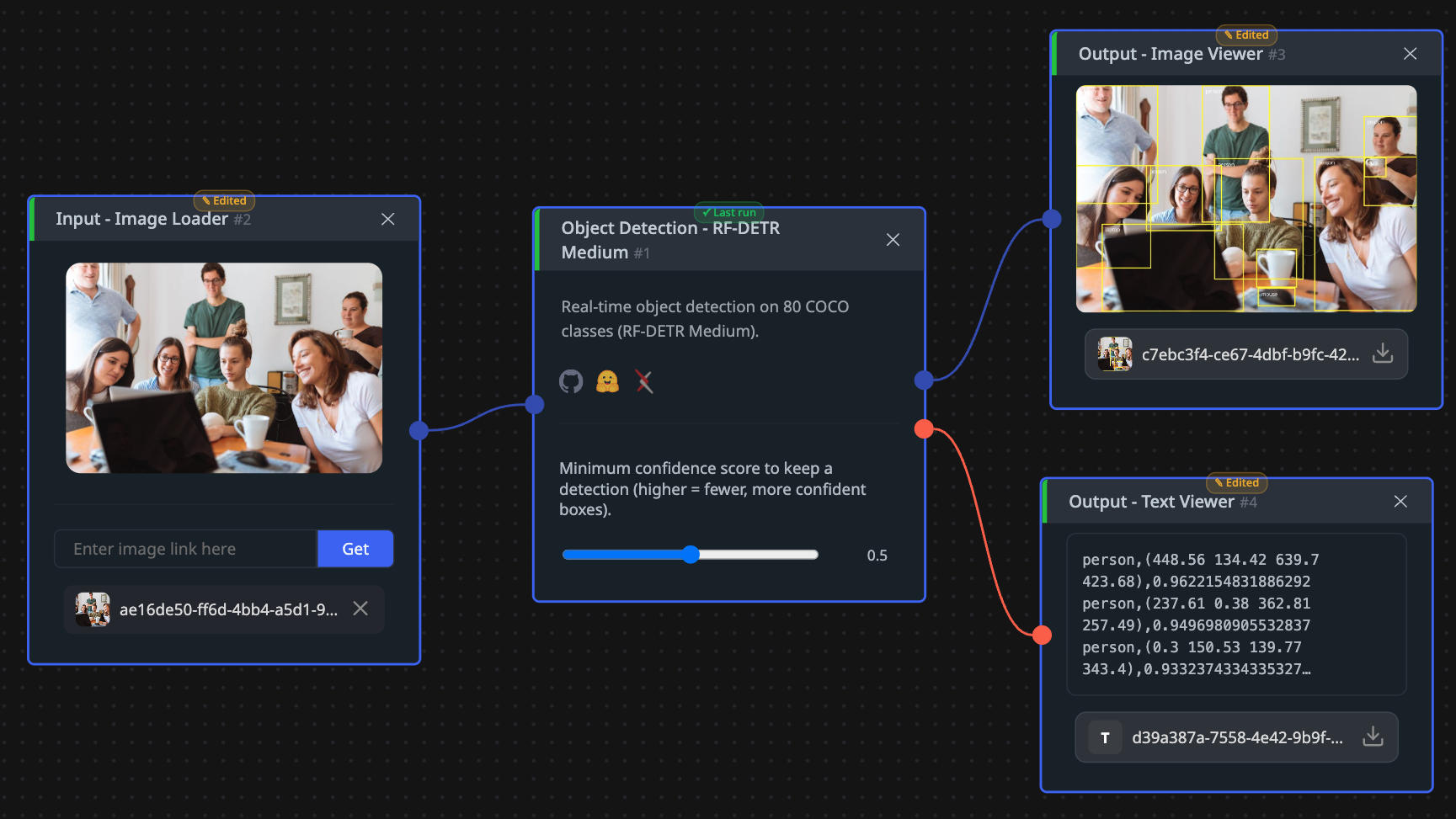
One setting matters in CNAPS Studio: a minimum confidence score, 0 to 1, defaulting to 0.5. Raise it for fewer, surer boxes; lower it to see the weaker guesses, with 0.35 to 0.5 a sensible range. Output is a label, a box as left, top, right and bottom pixel coordinates, and a confidence score per object kept.
The published numbers
On COCO 2017 validation it scores 54.7 average precision, the strict measure that averages across how tightly the box has to match, and 73.6 on the loose measure that only asks for rough overlap. Both are out of 100. It reaches that at 4.4 milliseconds per image working at 576 by 576 pixels, measured on a small inference GPU with an optimised runtime and one image at a time.
A second benchmark is worth more than the first for practical work. RF100-VL is a hundred real-world datasets rather than everyday photographs, covering things like industrial parts and medical imagery, and there it scores 61.2 strict and 87.4 loose.
On credibility this is an unusually good case. Roboflow measured every model in its published comparison in-house with the same tooling over the full 5,000-image validation split, and says plainly that its figures may differ from vendor-reported ones. Uniform measurement across all entrants beats each model quoting its own paper. It is still this model's vendor doing the measuring, so not independent, but the method removes the usual cherry-picking.
How it compares to the other detectors here
Against DETR the comparison is close to fair and still needs a caveat. DETR reports 42.0 on the same measure and the same validation split, but that figure comes from its own authors while 54.7 was measured by Roboflow. The gap is real and large; treat its exact size as approximate.
Choosing is straightforward. Reach for RF-DETR Medium as the default when you want boxes over everyday objects and care about throughput. Reach for DETR when you want the older, heavily reproduced baseline or need its wider 91-category list. Reach for RF-DETR Seg Medium when a rectangle is not enough and you want the object's exact outline, and RF-DETR Keypoint when the subject is people and you want their joints. When the thing you want is not on the category list at all, SAM 3.1 (Scene) will find it from a text phrase.
What to chain it with
It takes one image and returns labelled boxes with confidence scores, the standard detector output that the rest of the catalog is built to consume.
Two chains carry most of the work. Image Crop by Class cuts out every object of a given label, turning a shelf photo into one image per product, which goes to Object Classification or BLIP (Image Description) for a finer read. Image Masker by Class converts the boxes into a mask instead, feeding Selective Blur to obscure what you found or PowerPaint to remove it. For sorting a batch, Image Gate by Text passes a photo onward only when a chosen label appears.
Open RF-DETR Medium in CNAPS Studio, run your own images at the default 0.5 threshold and again at 0.35, and see how many real objects were sitting just under the cutoff.
Sources
- github.com/roboflow/rf-detr for the Apache 2.0 license, the 33.7 million parameter count, the 54.7 and 73.6 COCO scores, the RF100-VL scores, the 4.4 millisecond latency and 576 by 576 resolution, and the statement that every row was measured in-house over the full validation split.
- huggingface.co/Roboflow/rf-detr-medium and arXiv:2511.09554 for the architecture, the training data, and the architecture search behind the family.
- huggingface.co/facebook/detr-resnet-50 for DETR's 42.0 average precision and its 91 categories.
- docs.cnaps.ai/ai-model-hub for the CNAPS Studio input, output and confidence threshold.