
Apache 2.0, weights free on Hugging Face, nothing to accept. The 5 billion parameters split into a 3-billion half that reads and a 2-billion half that paints, which keeps self-hosting on a consumer graphics card rather than data-centre hardware. In your browser it runs on CNAPS Studio, included in the basic plan.
The pitch is coverage. One set of weights handles five different jobs: make a picture from text, change a picture from a written instruction, do either of those when the instruction needs a step of thinking first, and render legible words inside the image. Its authors published a score for every one of those, which is more than any other generator in this catalog offers.
Two costs, and the first is unusual enough to lead with. Almost nobody is using it: 17 downloads in the last month, the lowest figure of any model we carry. Nothing has been reproduced, no community has mapped its failure modes, and the ranks on its scoreboard are its authors' own reading. The second is size, since the studio generates at 512 by 512 by default while most of its neighbours start at 1024. Seven image generation models sit in the CNAPS Studio catalog, and this is the one that covers the widest range of jobs.
What it actually is
Two halves with an unusual join. A 3-billion-parameter vision-language model reads the prompt and any reference image; a 2-billion-parameter diffusion transformer paints the result. What sits between them is the paper's actual contribution, called Stacked Channel Bridging: instead of passing only the reading half's final output to the painter, it draws features from several depths at once and fuses them with learnable tokens the authors call think tokens.
Training ran in three stages. First an alignment stage on image-text pairs and editing triplets, teaching the two halves to speak to each other. Then joint supervised fine-tuning across generation, editing and reasoning together rather than one after another. Then reinforcement learning against a mixture of reward signals, which is the stage aimed at human preference rather than accuracy.
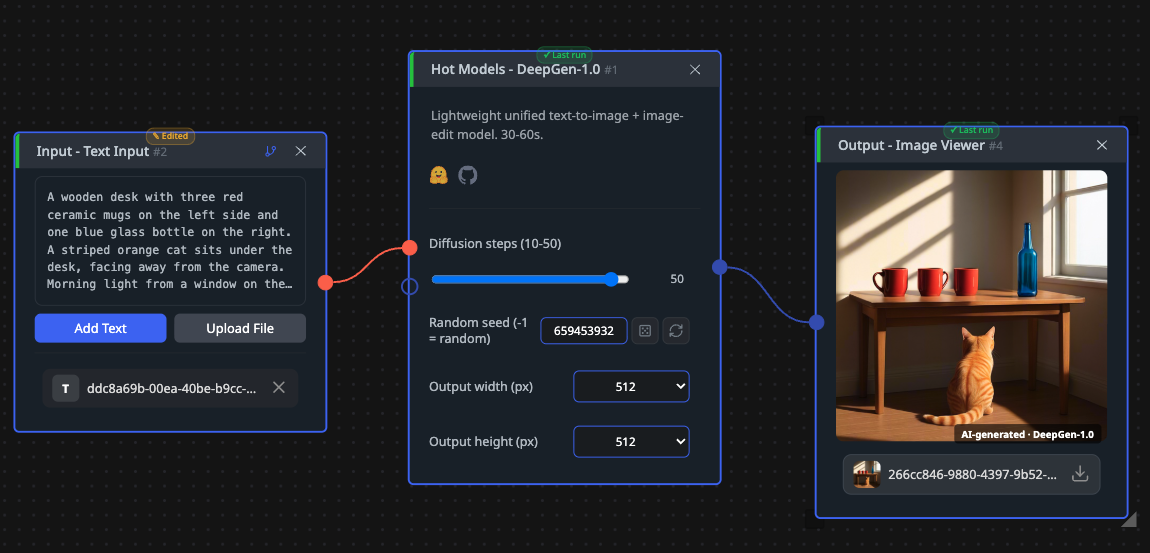
The studio exposes three controls. Diffusion steps run 10 to 50 with a default of 50, which is the full amount rather than a shortcut, so this is not a speed-first model. Output height and width default to 512. A seed makes a result reproducible. Reference images are optional; text alone is enough.
Parameters5 billion: a 3B vision-language half and a 2B diffusion transformerKey ideaStacked Channel Bridging, fusing features from several depths with learnable think tokensTrainingAlignment pre-training, then joint supervised fine-tuning, then reinforcement learningJobsGeneration, editing, reasoning generation, reasoning editing, text renderingInputsText, or one or more reference images plus an instructionSteps10 to 50, default 50Default output512 by 512PaperFebruary 2026LicenseApache 2.0Downloads last month17
The published numbers
Nine scores across five jobs, all from the model card. They are listed below by what they test, and none of them share a scale with each other.
JobBenchmarkScoreGenerationGenEval0.87GenerationDPGBench87.90GenerationUniGenBench75.74EditingGEdit-EN7.17EditingImgEdit4.14Reasoning generationWISE0.73Reasoning generationT2I-CoREBench46.5Reasoning editingRISE13.3Reasoning editingUniREditBench77.5
What to make of them. Every figure is vendor-reported, from a paper published in February 2026, with no third-party reproduction. The placings the authors claim are their own comparison against a list they chose. And the download count means nobody has independently confirmed any of it, which for a model with this many published claims is the thing to hold in mind.
One correction against our own documentation: our model page lists 13.3 as 10.8 and 77.5 as 75.7 on the two reasoning-editing rows. The model card is the source of record and the table above follows it.
How it compares to the other image generators here
DeepGen-1.0GLM-ImageOmniGen2FLUX.2 KLEIN 4BSize5B16B across two stages4B4BText to imageYesYesYesYesEdits an existing imageYesYesYesYesMultiple referencesYesYesYesYesPublished scoresNine, across five jobsSeveral, mostly on text renderingNone on the model cardNoneDefault output512 by 5121024 by 10241024 by 1024512, 768 or 1024 squareLicenseApache 2.0MITApache 2.0Apache 2.0
No two of those score columns can be compared, because the models were measured on different benchmarks or not measured at all. What the table does show is that the four overlap almost completely in what they accept, so the choice between them is not about capability.
Reach for DeepGen-1.0 when the instruction needs interpreting rather than following, which is what its reasoning scores are about, and when you want a model whose claims are at least written down. Reach for GLM-Image when words have to appear correctly inside the picture. Reach for OmniGen2 when you are blending several reference images and want the most-used option of the group. Reach for FLUX.2 KLEIN 4B when speed and a small footprint decide.
What to chain it with
Text in, or images plus text, and one picture out. Because it both makes and changes pictures, it can occupy either end of a chain or sit in the middle of one.
Two chains are worth building. Since the default output is 512 pixels, enlarging is close to mandatory before anything real: PiSA-SR or SMFANet+ takes the result to a usable size, and doing that before further editing rather than after gives every later step more to work with. For product work, BiRefNet (Subject) cuts a real object out of a photograph and hands it here as a reference image, so the object keeps its true shape while the scene around it is written rather than photographed.
Open DeepGen-1.0 in CNAPS Studio, give it an instruction that needs a step of inference rather than a literal description, and see whether the reasoning scores mean anything on your own prompts.
Sources
- huggingface.co/deepgenteam/DeepGen-1.0 for the Apache 2.0 license, the 5 billion parameter count and its split, Stacked Channel Bridging and think tokens, the three training stages, the five supported jobs, all nine benchmark scores, the February 2026 paper, and the monthly download count.
- docs.cnaps.ai/ai-model-hub for the CNAPS Studio step range, default output size and seed, and for the other image generators in the catalog.