
Apache 2.0 from Baidu's PaddlePaddle project, weights free, nothing to accept. It is three small networks in sequence rather than one large one, which is why it runs on an ordinary processor with no graphics card. In your browser it runs on CNAPS Studio, included in the basic plan.
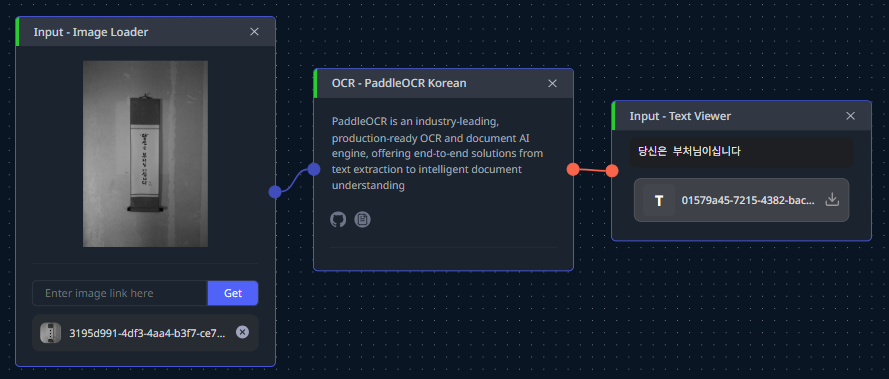
It is not a document model, and that distinction matters. It is a text finder and reader, tuned for Korean and English, and it returns the strings it found with the boxes they sat in. Point it at a menu, a street sign, an identity card or a screenshot and it hands back the characters. Point it at a twelve-page report and it will read every line without telling you which column came first.
The published accuracy deserves reading carefully for the same reason. The Korean recognition model scores 88.0 percent, and that is line-level accuracy on Korean text data rather than a score for reading a page. Three OCR models sit in the CNAPS Studio catalog, and this is the lightest of them and the only one tuned for Korean.
What it actually is
A pipeline of three stages, each its own network. Detection finds the regions of the image that contain text at all. An orientation step straightens lines that were photographed at an angle or upside down. Recognition then reads characters out of each straightened line. Splitting the work that way is what keeps the whole thing small.
The generation is PP-OCRv5 and the recognition weights are the Korean ones from it, covering Korean and English together in one model. The wider family ships separate recognition models for other script groups, but this catalog entry is the Korean one specifically.
Input is any image carrying text: JPEG, PNG, BMP, GIF or a PDF page, at any size, though the studio is tuned for something between 800 by 1200 and 2048 by 2048. Output is the recognised text together with the coordinates each piece came from. There is nothing to tune: no quality dial, no strictness setting.
GenerationPP-OCRv5, Korean recognition weightsPipelineDetection, then orientation, then recognition, as three separate modelsLanguagesKorean and EnglishInputJPEG, PNG, BMP, GIF or a PDF pageOutputRecognised text with the coordinates of each piecePublished accuracy88.0 percent, Korean text linesLicenseApache 2.0Downloads last month5,551 for the Korean recognition weights
The published numbers
One number, and it is narrower than it looks. The Korean PP-OCRv5 recognition model is published at 88.0 percent accuracy on Korean text line data, reported as a large improvement over the previous generation's Korean model. That is accuracy on a line of text which has already been found and straightened, not a score for reading a whole image.
What that leaves out is where most real failures come from. Nothing is published for the detection or orientation stages, so the figure cannot tell you how often a line on a curved sign or a low-contrast menu is never found at all. Two of the three stages go unscored, and they are the two that run first.
Adoption is modest at 5,551 downloads in the last month for the Korean recognition weights, though that understates the family's reach, since most people install PaddleOCR as a package rather than pulling weights.
One note on our own documentation. Our model page quotes a wider set of figures, 92 to 95 percent on printed text and 70 to 85 percent on handwriting, and PaddlePaddle publishes neither. The 88.0 above is the number with a source behind it.
How it compares to the other OCR models here
PaddleOCR (PP-OCRv5 Korean)GLM-OCRDeepSeek-OCRTypeDetection and recognition pipelineVision-language modelVision-language modelSizeThree small models in sequence0.9B3BPublished score88.0 percent on Korean text lines94.62 on OmniDocBench V1.5, 75.2 on olmOCR-bench73.99 on Real5-OmniDocBench, 75.7 on olmOCR-benchOutputText with coordinatesMarkdown, formulas, tables, JSON recordsMarkdown, plain text, figures, coordinatesKeeps layoutNo, positions onlyYes, reading order and structureYes, markdown structureLicenseApache 2.0MITMITDistinctiveKorean-tuned, and light enough for a processor with no graphics cardField extraction against a schema you writeToken cost is a setting you choose
The scores in that row do not share a scale and should not be read as a ranking. PaddleOCR's 88.0 grades one line of Korean text that has already been located, while the other two grade a whole page against a reference version of it. Only the two olmOCR-bench figures in the right-hand columns are directly comparable to each other.
The choice is about shape rather than quality. Reach for PaddleOCR when the text is Korean and short, when it sits on a photograph rather than a document, and when you want the answer immediately. Reach for GLM-OCR when the page has tables, formulas or named fields worth keeping structured. Reach for DeepSeek-OCR when the pages are feeding a language model and what you are managing is its budget.
What to chain it with
One image in, text and coordinates out. The coordinates are what make it a component rather than an answer.
Two chains earn their place. Those boxes feed Image Crop by Coord, so the exact region a string came from can be cut out as an image, which is how a stamp or signature stays attached to the record. The same boxes feed Selective Blur for the opposite job, blurring the name and number on an identity card while leaving the rest of the photograph readable.
In front of it, cleaning up is often the difference between reading a sign and missing it, since detection fails on soft edges. Real-World Blur Removal or Motion Blur Removal (MSSNet) recovers a photograph taken in a hurry, and SMFANet+ enlarges text that is simply too small to resolve.
Open PaddleOCR in CNAPS Studio, run the same sign photographed straight on and then at an angle, and see how much of the difference the orientation step absorbs before you rely on it in the field.
Sources
- huggingface.co/PaddlePaddle/korean_PP-OCRv5_mobile_rec for the Apache 2.0 license, the 88.0 percent recognition accuracy, the Korean and English coverage, and the monthly download count.
- github.com/PaddlePaddle/PaddleOCR and the PP-OCRv5 multilingual documentation for the three-stage pipeline, the PP-OCRv5 generation, and the improvement over the previous Korean model.
- huggingface.co/zai-org/GLM-OCR and huggingface.co/deepseek-ai/DeepSeek-OCR for the comparison rows.
- docs.cnaps.ai/ai-model-hub for the CNAPS Studio input formats, the resolution guidance, and the output shape.