
DETR (Face Detector): a one-class fine-tune for finding faces, and where to run it
Start with the availability, because it is unusual for this catalog. This model is under legal review and is not available to users in the European Union or the United Kingdom. Everywhere else it runs in your browser on CNAPS Studio, included in the basic plan. The weights are Apache 2.0 and free to download, and at 41.6 million parameters self-hosting needs only PyTorch, the Hugging Face transformers library, and a GPU if you want speed. A lawful use case in a restricted region means a conversation with our legal team rather than a switch we can flip.
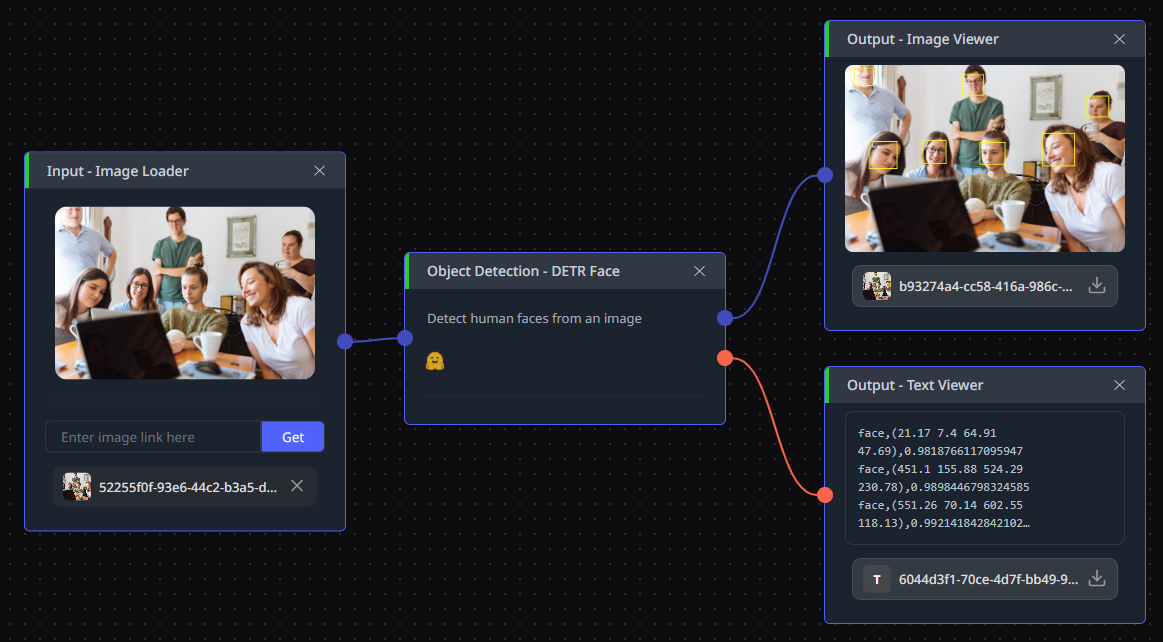
What it does is one job: hand it a photo and it returns a box around every face it finds, each with a confidence score. It is a fine-tune of the general DETR detector, retrained so that its classification head answers face or background instead of naming one of 91 everyday categories.
The cost is accuracy, and the published numbers are blunt about it. Averaged across face sizes it scores 8.96 out of 100 on the standard detection measure. Close-up faces are the exception rather than the rule, and everything else falls away sharply. Two DETR fine-tunes sit in the CNAPS Studio catalog and this is the one for finding people in a frame, on the understanding that it finds the obvious ones.
What it actually is
The architecture is inherited from DETR unchanged: a convolutional backbone, a six-layer transformer encoder, a decoder running 100 object queries, and prediction heads. The only change is at the end, where the classifier chooses between two options rather than 91. The 100-query ceiling carries over, so one image cannot return more than 100 faces.
Training ran for 70 epochs from the general DETR checkpoint, using the AdamW optimiser at a learning rate of 5e-05 with cosine scheduling. The training dataset is not named on the model card, which matters more than it usually would: for a face model, not knowing what it was trained on means not knowing whose faces it works well on.
Output is a list. For each detection: the label face, a box given as left, top, right and bottom coordinates, and a confidence score from 0 to 1.
The published numbers
These come straight from the model card, scored out of 100 on the standard detection measure, where higher is better and the score rewards both finding a face and boxing it tightly.
Overall it scores 8.96. Split by how big the face is in the frame, large faces score 55.14, medium faces 21.11, small faces 1.35. Overall recall, the share of faces it finds at all, is 15.65. At the loosest box-matching threshold the score rises to 22.01, which says a good part of what it misses is box precision rather than the face itself.
Two things to hold onto. All of these are the author's own evaluation numbers, and the card gives no intended-use or limitations section, so there is no third-party check and no guidance from the person who trained it. And the model is barely used: six downloads in the last month, against 613,233 for the general DETR it was built from. Treat it as a starting point you validate on your own footage, not a component you trust unattended.
How it compares to the other detectors here
A face is not a general object, so lining this up against the general detectors by score would compare two different tasks. What can be said is that the general DETR scores 42.0 on the same measure across 91 categories while this fine-tune scores 8.96 on one, a large gap in the wrong direction for a specialised model.
Practically: reach for this when you need face boxes, the faces are close to the camera, and a person will check the output. Reach for SAM 3.1 (Scene) instead when you want faces masked rather than boxed, or when small and angled faces matter, since a text phrase of face returns masks and it is not region-restricted. Reach for the general DETR when people rather than faces are what you are counting, since person is one of its 91 categories and it is far more accurate at it.
What to chain it with
It takes one image and returns labelled boxes with confidence scores, which is the same shape of output as every other detector here, so it drops into the same chains.
Two are worth naming. Image Masker by Class turns the face boxes into a mask, which goes to Selective Blur for anonymising a photo before it leaves your hands. Image Crop by Class cuts each face out separately, feeding Object Classification or BLIP (Image Description) when the next question is about the crop rather than the frame. Given the recall figure above, put a confidence threshold in front of either chain.
Open DETR (Face Detector) in CNAPS Studio, run one close-up portrait and one wide group shot taken from across a room, and let the difference between those two results set your expectations.
Sources
- huggingface.co/EsraaFouad/detr_fine_tune_face_detection_final for the Apache 2.0 license, the 41.6 million parameter count, the base checkpoint, the 70 training epochs and optimiser settings, every score quoted above, the absence of a named training dataset, the empty intended-use and limitations sections, and the monthly download count.
- huggingface.co/facebook/detr-resnet-50 for the general DETR architecture, its 42.0 average precision, and its download count.
- docs.cnaps.ai/ai-model-hub for the CNAPS Studio input and output, and for the regional restriction and legal review status.